
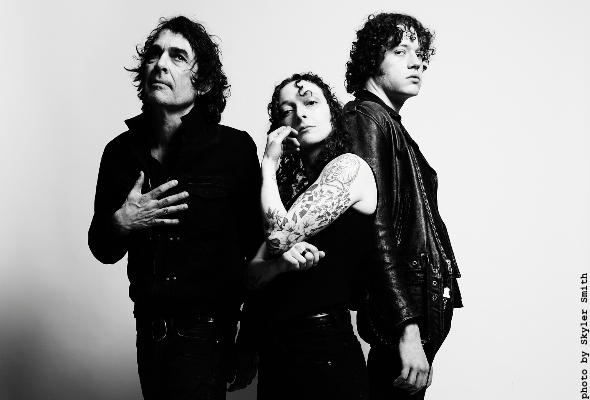
For those interested in the noisier end of the rock & roll spectrum, Jon Spencer needs no introduction. As the leader of rock deconstructionists Pussy Galore and frontman and namesake for the decidedly groovier but no less incendiary Blues Explosion, as well as a sideman with the Gibson Bros, Honeymoon Killers, and wife Cristina Martinez’s Boss Hog, among others, he’s had a hand in some of the greatest sides of vinyl of the last 40 years. But in the decade since the Blues Explosion’s dissolution, Spencer has hardly kept still. He’s seemingly constantly on the road, with bassist Kendall Wind and drummer Macky “Spider” Bowman of The Bobby Lees in tow, playing songs from throughout his career. And he is set to release a new album, Songs of Personal Loss and Protest (Shove Records), this week. The second album the trio has recorded together, it exhibits many of Spencer’s calling cards while still being an invigorated take on kicking out the jams.
I caught up with Spencer on the phone last month to discuss the new record, what keeps him going, and what pisses him off.
It seems like you’re on the road a lot. Every time I’m on social media, it seems like you’re posting new tour dates.
Jon Spencer: Well, that’s two things. First, I love to do it. My favorite thing about playing in a rock & roll band is to play in a rock & roll band, to play shows. It’s what I love to do. But it’s also our bread and butter and how we let people know about the band.
Is that necessitated by the fact that you don’t make any money from selling records these days?
JS: Don’t get me wrong, I have nothing against money, and I’d like to have lots of it, but the reason I’ve always been in bands is because I love playing in bands and I like to make a racket. I fell in love with this kind of thing. I’ve never thought about it as a career, even though it is my career—it has become my work—but if I were really serious about wanting to be rich and famous, then I would be doing things very differently. So I wouldn’t call it a necessity. It’s like a compulsion, an obsession, you know, a love affair.
How do you occupy your time when you’re not touring?
JS: I am, for better or worse, the manager of the band and this career, if you will. My time is largely spent just promoting, posting on social media about where we’re going to be playing and getting the word out. And there’s a ton of work to be done, all sorts of details that go into booking and promoting a tour or releasing an album. So my time is spent doing a lot of busy work. Some of it can be creative, but a lot of it can be pretty tedious, sadly. I came out of punk, and for America, punk really was hardcore. Hardcore wasn’t my favorite kind of music, but it was the bolt of lightning that made me think, “Oh, I could do this!” If that person is up there playing in a band, then I could probably do it. And it was the thing that taught me, if you want to be in a band, then start a band. If you want to put out a record, you can do that. You don’t need to get permission from anybody; you can just put it out yourself, though you might have to work some crappy job to get the money together. On every level, there was the do-it-yourself attitude. So I came out of that, and so I’m very hands-on and call the shots.
What has happened with music today is that people just expect to get it for free, and that spills over to touring as well. More and more, the onus is on the artists to promote the shows. Bands are expected to work their asses off and do things that traditionally other people did while at the same time receiving a much smaller share of the pie.
Has working with Kendall and Spider changed your perspective on how to go about things?
JS: No, not really. I’m still doing stuff the same way. It may not be the smartest way for fame and fortune, but that’s not what’s important to me. What’s important to me is to play a good show and to make a good record. And playing with Spider and Kendall is wonderful. I love it, and I want very much to continue doing that, but it’s not like we’re sharing in the workload. But that’s always been the case with all of my bands. I take on the job.
Has working with them made you feel reinvigorated?
JS: Yeah, it’s wonderful to play with Kendall and Spider. They’re such excellent musicians and so easygoing. They’re so positive, and there are never any problems. And they have a lot of energy, so we’re able to play a very intense, very high-energy show. I really enjoy not having to use a set list—the Blues Explosion never used a setlist—and it’s very nice to be able to do that again with this new band. They’re extremely capable. So yeah, I guess it’s reinvigorated me, but I also get a real kick out of playing old songs, especially the Blues Explosion songs. This lineup is a traditional rhythm section with a bass guitarist, whereas the Blues Explosion had two guitars. So Kendall’s basically filling the Judah Bauer role, and I get a real kick out of the ways in which she translates the six-string guitar parts for her four-string electric bass.
Having a three-piece band again, does it feel like Blues Explosion Mach 2 or like an entirely different beast?
JS: There are similarities—it is a trio—but I’d like to think that it’s not just a rehash. The Blues Explosion was a very special thing, and what made it special in my estimation were the three people—Judah Bauer, Russell Simins, and myself—and it doesn’t work with anybody else. It was very unique to the three people and the ways in which we were able to write together and to communicate onstage. So yeah, there are some similarities, but I think that the trio with Kendall and Spider is a different kind of beast.
Was there something that instigated wanting to do the Pussy Galore songs again?
JS: One thing that was sort of an inspiration for me is seeing Kid Congo with his band, the Pink Monkey Birds. They have their own songs, but then they would play songs from some of the different bands that he’s been in over the years. They’d play a Cramps song, and then they’d play a Gun Club song. And I thought that was so cool and that I’d like to be able to do that. So we started bringing in older songs into the set. It’s now been two or three years that I’ve been playing with Kendall and Spider, and over that time, we now have a lot of our own songs. With this new record, Kendall and Spider were a bigger part of the actual writing and the composition, and I think as the band continues, they will be even more involved with the songwriting.
You pretty much wrote all the songs yourself for the Hitmakers records and the record under your own name. But it sounds like this one was more collaborative then?
JS: Yeah, the Hitmaker songs I wrote just on my own. And then the first record I did with Kendall and Macky, Sick of Being Sick, that was me writing all those by myself. This album started in the same way, where I pretty much wrote all the songs, but when I presented them to Kendall and Macky, there was more room for them to bring their own parts to the songs. That’s why we’re sharing in the songwriting credit.
You’ve always kind of worked in a band. Would you ever feel comfortable making a record entirely on your own, or do you need that collaboration?
JS: I really do love playing with people. I like having a band. The first Hitmakeers album, Spencer Sings the Hits, it was credited to “Jon Spencer,” but that is a Hitmakers album. There were supposed to be three Hitmakers albums; it was planned as a trilogy. But it was kind of like a solo record. I was writing on my own, and then I met up with Sam Coomes and Sord at the Key Club recording studio in Michigan. I showed them the songs, and we recorded them one by one, and then I went back and did overdubs, so that sort of felt like making a solo record.
Maybe like 25 years ago, I made an album with Cody and Luther Dickinson of the North Mississippi All-Stars. I went down to work at their father Jim Dickinson’s Zebra Ranch Studio in Coldwater, Mississippi. That was a similar thing where Cody, Luther, and I had never played together. I just went in with a bunch of songs. So I think in some ways I’ve made a solo record before, and it’s not really my thing. I much prefer having people to collaborate with and bounce ideas off of.
When you were in that transitional period between Pussy Galore and the Blues Explosion and playing with like the Gibson Bros. and the Honeymoon Killers, did you know you wanted to start your own band again at that point?
JS: Yeah, I became very aware of missing having a band. But it’s not like I went at it. The Blues Explosion sort of happened by chance. We met through the Honeymoon Killers because both Russell and I were playing with them. So yeah, I wanted to have a band, but it’s not like I was putting flyers up or placing classifieds in The Village Voice.
I produced an album for Samantha Fish with a guitar player, Jesse Dayton, called Death Wish Blues. I was given the task of putting the band together. I asked Kendall to play bass because I’d worked with her when I produced the second Bobby Lees album. I was really impressed with her playing. She was really flexible in the sense that she could hear a song and then play it. And if you asked for something slightly different, there was no problem, so she was really great in the studio.
When Death Wish Blues was finished, Samantha and Jesse were getting ready to tour, and Samantha very kindly asked me if I wanted to support them on some of the shows. I said, “Yeah,” but I didn’t have a band. The Hitmakers had finished, and the Blues Explosion was long gone. So I just thought I’d get a rhythm section together, and so I called up Kendall. The Bobby Lees had stopped, so she said she would be happy to do it, and she thought Macky would be up for it as well because he was also out of work. So it wasn’t like there was this long and labored thing where I was auditioning people. It happened more organically.
Is the production work something that you actively seek out?
JS: I enjoy doing it and like being in a studio, but no, I don’t actively seek it out.
What is your approach like, and does it differ dramatically between someone like Samantha Fish and, say, the Cheater Slicks?
JS: It’s very different. The Cheater Slicks are my friends, and while I’d like to think Samantha is my friend, making a record with the Cheater Slicks had different stakes and was a different kind of affair. Making a record for Samantha, there’s a different set of expectations. My biggest teacher was Steve Albini. I learned so much from Steve, not only about making records, but also about having a band and running a band. It was this idea of DIY and responsibility. Steve was incredibly generous. He was an amazing engineer, and he would share his knowledge with anyone and was happy to do it. But the big thing for me was his demystifying of the studio so it wasn’t like this magician’s closet. You might have to work a shitty job to pay for the studio time, but once you’re in there, if you want to take the gas tank from an old Ford and beat the shit out of it and throw it down the stairs and record the sound of that, well, you paid for the time and you can do that so long as you’re not damaging anything. Steve was never like, “Oh no, we can’t do that.” He’d say, “That sounds like a really cool idea, and I know just the microphone to use for that.” Then he’d happily set about running cables and setting up the microphone, and would tell you why it is a good choice of microphone. Steve’s whole thing was “It’s not my record, it’s your record.” So whether I’m working with the Cheater Slicks or Samantha Fish, it’s not my record, it’s their record. To be a producer, you have to be sympathetic to the situation and to the artist.
Having worked on a Grammy-nominated album, have you had more requests?
JS: No, not a one!
Given the title of the album, do all the songs fall into one camp or the other, themes of either personal loss or protest?
JS: I think you have to stretch a little bit to fit some of them in a category, but yeah, let’s say they all fit into one camp or the other. Sure, why not?
“Hangover” seems the most overtly political…
JS: Well, “Step on the Gas” is probably the most overt call to action. This isn’t the first time I’ve gotten political. As far back as the Blue Explosion, there were songs inspired by current events. The tricky thing is I don’t want to be a nag. I don’t want to be pedantic and say you’ve got to think this way and vote like this on that. And the other thing is, if you make a song about a very specific event or person or cause, then that song loses some meaning or value as time goes by. It’s not that I’m trying to be vague; it’s that I think that the best kind of art invites the listener or viewer or reader in and allows them to make their own way and take what they want out of it.
Obviously, it’s usually people from the right who say to keep your politics out of the music, because they don’t want to just listen to shitty music. But to me, an artist is always going to sing about what’s on their mind, right?
JS: First of all, I just want to say fuck those people because I’m so sick of this fucking hypocrisy. They want to keep politics out, but then they’re all about ramming their politics down everyone else’s throat. This thing with Comey, they’re trying to send him to jail because he posted a photo of seashells saying “86 47?” How many years have we put up Fuck Biden flags? Trump himself is constantly espousing violence. The hypocrisy is just too much. I’m so sick of it. And everyone bitching about the Super Bowl halftime show can fuck off. What has America given to the world? Jazz and rock & roll. And where did these art forms come from? Who are the people who birthed these art forms? Let’s look at rock & roll. It’s Little Richard, a black man, a bisexual, a queer, a drag queen. These are the very people that the current administration is seeking to erase. They want to deny that people like that existed. They are actively erasing history. So you could make an argument that just picking up a guitar and playing rock & roll is in and of itself a political act. And I’m not the first person to say that.
I’m so fucking disgusted and pissed off at these assholes. I’m so goddamn sick and tired of listening to them. I can’t wait for a world in which I don’t have to look at that guy’s face and don’t have to hear his voice. And I don’t think I’m alone. Most people are so sick of this guy. So yeah, it’s unavoidable.
Have you ever faced any backlash from your audience?
JS: No, with the people paying to see my band, it’s kind of preaching to the converted. Pretty much every night, I’ll go into a rap. I try to be careful not to spin out of control. I usually just try to appeal to people’s better judgment and good sense, like we’ve got to take care of each other.
There was one time when we got some backlash. We were playing a show supporting Samantha Fish in Southern California, and Trump had just been named Time’s Man of the Year. So I started a rap and saying things like, “How is this any example for our children? Is this the person you want to put forward as a man of the year?” And people started booing and chanting “Trump.” Again, all I was saying was, “This is the man of the year, this convicted felon who has been accused of sexual assault and rape? Who lies constantly, who incited a fucking to a riot?” Why was that not just like, “No, game’s over. You’re going to jail.” Why the fuck couldn’t our country do what Brazil has done? You try to overthrow the government—that’s it. You’re out. You don’t get to be in the government anymore. It’s just un-fucking-believable. I don’t know what’s going on.
The last time I saw you play was actually in Columbus, and I was just so impressed. You just came on like a storm and didn’t let up.
JS: You asked about getting reinvigorated playing with Kendall and Mackey, and yeah, it’s great to be able to play with excellent musicians with a lot of energy and who can handle this kind of job. It’s great to be able to not have a set list and to be able to come out and blaze.
Yeah, and there’s always been a certain amount of showmanship to what you do, so I was curious if you have to get yourself psyched up to do that or if it’s like you slip into another persona almost?
JS: It’s a show, but it’s still me, I guess it’s another facet of myself. It’s kind of like another persona, but that makes it sound a little fake. But it’s not like you can just go on cold. There are things I do before playing to prepare. One thing is what I guess you’d call a meditation, but it’s really just thinking about what’s about to happen.
You’ve played with several old-timers over the years. Do you see yourself continuing to do this in old age like RL Burnside?
JS: That would be nice if I could physically do it. I’ve never really been good at planning. I love playing in a band and I love rock & roll music. Playing a concert is a very special thing. It’s a kind of a religious thing, like a communion. It’s a very deeply spiritual kind of connection with people. It’s the band. It’s the other people in the room. I’s a really powerful thing that does something for me. So yeah, I’d like to keep doing it. Some of my heroes, like Rufus Thomas or Charlie Feathers, were artists doing something very idiosyncratic and very unique to themselves. They were a little bit off the beaten path, but they followed this path all of their lives. And it just seems to be ending up that way for me as well. I don’t know if playing with Kendall and Macky is the same as when I was playing with RL, but I really have no problem with that concept. I’ve thought about it myself, like, “Now it’s my turn. Somebody come and lift me up out of the obscurity!”
Your Comments