
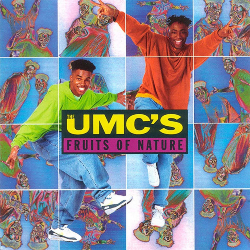
 Leaning into the Staten Island–ness of the UMCs’ origins and eventual brief success would be a disservice to Kool Kim and Haas G (who now goes by Fantom of the Beat), the enigmatic duo who became the Undisputed Masters of Charisma in 1989, at the height of hip-hop’s golden age.
The UMCs’ first single, “Blue Cheese,” was ubiquitous in the fall of 1991, at a time when ’90s conscious rap was riding a wave, with celebrated releases from Native Tongue artists like De La Soul, A Tribe Called Quest, and Black Sheep. “Blue Cheese” was a hip-hop hit, and for a moment, The UMCs seemed poised for a crossover.
A pitched chant lifted from Solomon Burke and an oft-used Funkadelic break from 1981 aligned The UMCs with other backpack, boom-bap progenitors. But it was the beat provided by producer RNS for “Blue Cheese” that made it undeniably infectious, while a whistle from the Delegation jam, “Oh Honey,” centers the track and gives it an effortless whimsy. But, at first, RNS didn’t want to give up the goods. It was that good.
“From my personal estimation, RNS wasn’t a big fan of mine,” remembers Kool Kim. “He didn’t really want to give us the beat. Whatever happened, he changed his mind. We were still in school at the time. We both had the tape, and we were on the phone, going back and forth writing the lyrics. ‘Blue Cheese’ just came out of nowhere. We could have named it anything, but we were trying to be abstract but also intellectual.”
“I love that,” says Fantom. “It was abstract intellectual. To me though, ‘Blue Cheese’ has a meaning. For me, it meant anything that’s whack. It became something that made sense, but at first it made no sense. Like ‘Potholes in My Lawn,’ what does that mean? Eventually it had meaning.”
Both Kim and Fantom were born in Brooklyn, but eventually moved to Staten Island, inhabiting the Castleton Park and Stapleton projects. The two were no doubt inundated with the culture being created in the other boroughs, but in an age when portable phones and the internet didn’t exist, Staten Island may as well have been another planet. This was before “Shaolin” was a place on the map, when the only noteworthy group from Staten was the Force MDs, who told us “Love Is a House.”
The UMCs’ story is not one of despair or violence, drugs, or gangs, and that’s reflected in the cheery aesthetics adopted by the duo soon after their formation: a little Kid N’ Play, a little Jungle Brothers, and some Das EFX and Naughty by Nature for good measure. They met on the Staten Island ferry when both were working on Liberty Island, soon realizing they both had an affinity for writing and performance. Both were salutatorians in their high school class; both were raised by strong mothers determined for them to become successful; both were infatuated with the house music boom; and both studied dance, even appearing in a number of videos as back-up dancers and onstage at the Apollo (bizarrely with Mike Tyson). But being in the background was never a part of the plan that started to take shape on long pilgrimages to One West on 125th Street in Manhattan every Wednesday night.
“We would do a hip-hop night there,” says Fantom. “That’s where we got our performance chops, where we got our bones. We perfected our craft in front of that crowd. We had uptown locked from that experience. And it goes without saying, we always had our demo tape at the ready.”
“We wanted to be world famous. There was a bigger picture,” says Kim. “We were trying to be aspirational. We were willing to be artistic, off the beaten path. What was great about us was that we had our influences, be it Tribe, De La Soul, the Ultramagnetic MCs. We were just two young cats from Staten Island, but the conversations we would have after going to these places that were uncharted for others where we were from were our big motivator.”
Their demo ended up in the hands of Gang Starr, and eventually into the offices of Wild Pitch, a label with a stable of emerging talent and East Coast buzz. Records from Main Source and Chubb Rock, and of course, Gang Starr’s masterful debut, 1989’s No More Mr. Nice Guy, propelled Wild Pitch into a lucrative distribution deal with EMI. Though conceptually alien from the rest of the artists on the label, The UMCs’ demo, which included “Blue Cheese,” and their second single, “One to Grown On,” was enough to get them signed and the freedom to record Fruits of Nature as they saw fit.
“I was raised Five-Percent Nation of Islam, and as a Jehovah’s Witness,” says Fantom. “So my head was just boggled by religion. I was conflicted, but I knew religion felt good, so I had to take the best out of religion. All I wanted to do was portray that to the world. I wanted to talk smart. We chose to appreciate the happiness, to look the other way, to appreciate what got us where we were. That’s what we wanted to show.”
“We were raised by our mothers,” says Kim. “So I’d be damned if I was going to get on that stage talking about a hard life that I wasn’t living. I was proud of that life. I was proud of everything that we had achieved as The UMCs. We were the first.”
Indeed, in the back half of 1991, The UMCs were everywhere, and they were the first to represent Staten Island. The wacky, day-glo, Pee-Wee’s Playhouse vibe of the “Blue Cheese” video made it into regular rotation on Yo! MTV Raps, and the duo made two appearances on Soul Train (which Fantom says really was the pinnacle for the group). There was even a poster for Fruits of Nature featured prominently in the decor of Martin Lawrence’s living room on his then-hit sitcom, keeping them in the public eye even while the label was falling apart.
Though Wild Pitch would send the duo on a celebrated tour with Main Source and the Jaz (a mentor to a young Jay-Z) and eventually released a follow-up, Unleashed, three years later, the shine of success had worn off rather quickly. The label had pushed them towards a harder sound, which belied what made them so magnetic and lovable to begin with.
“Wild Pitch was poorly run,” says Kim. “At the time, the owner followed the industry trope of robbing the artist. It’s like we were pets that he didn’t think required to be compensated for our work. At some point, almost every act he had found themselves in some sort of physical conflict with him. He had an amazing roster, but as opposed to taking care of it, he exploited it.”
But in speaking with Kool Kim and Fantom, there appears to be no hard feelings. Inherent in their positive vibes, they never had a chip on their shoulder, never felt the underdog status, always evolved, and both kept recording and producing for the next 30 years. In fact, they were in considerably high spirits about a UMCs return.
Though nowhere in their history do their paths cross or their styles mesh, there might not have been the Killa Bees without The UMCs. Kool Kim and Fantom were the Lewis and Clark for sleepy Staten Island; they were the first to prove there was life across the North Bay and the Verrazano, and to make the rest of the boroughs take notice.
Your Comments