
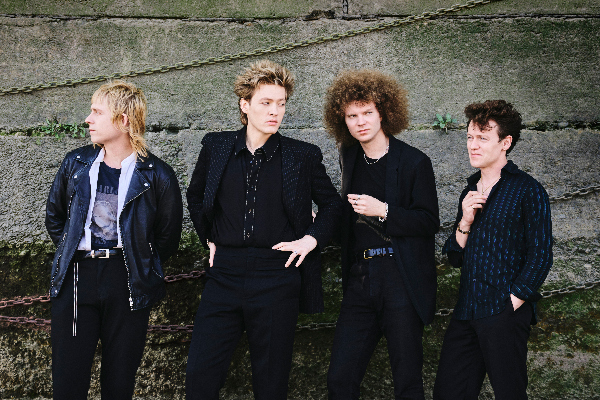
We first caught wind of Chicago’s Brigitte Calls Me Baby when they released their debut EP, This House Is Made of Corners, in 2023. It took just the record’s five songs to be smitten with the band’s mix of infectious melodies, hepped-up riffs, and singer Wes Leavins’ dreamy croon. They hearkened back to ‘50s leading lights like Roy Orbison and the King himself while also recalling The Smiths for Leavens dire odes to love and life. Indeed, when he sang about flowers and people and a place where he could be happy, you half expected him to follow those lines with “Take me out tonight.”
Brigitte Calls Me Baby released their debut full-length, The Future Is Our Way Out, the following year, expanding upon the EP’s five songs with another six every bit as impressive. And this month, they released their second full-length, Irreversible, an album that somehow seems more cohesive and purposeful than its predecessor. Whether it’s the riveting first single “Slumber Party,” whose line, “I thought I told you, no excuses to stay home,” seems like an answer to someone complaining about not having a stitch to wear, or the slow burn of “I Can’t Have You All to Myself,” this is an album that meshes big hooks with lyrics equally poignant and charming.
I caught up with Leavins a couple weeks ago on the phone to learn more about how it came into being.
Everyone talks about the second album being difficult because a band has its whole existence to work on the songs for the first one then the slate is cleared. Was this album more difficult to make?
Wes Leavins: Not really. We started it on the road. I’d have these “aha,” lightbulb moments where I’d get an idea in the van out on the highway heading to a gig.
So when you were coming up with things, did you work on them at soundcheck?
WL: Yeah, absolutely. We arranged songs at soundcheck. We would sometimes play them that night and then modify them.
Once you headed into the studio, did you have very specific ideas about what you wanted to do?
WL: Very much so. Lawrence and Yves helped us elevate the live thing. We wanted to keep the integrity of how exciting the songs felt live and retain that feeling. So, when we were in the studio, the producers had great ideas as to how to keep that feeling
Was there a specific reason why you went with the Rothman brothers?
WL: We had a vision for the album. When we met with them initially, I let them talk and tell me what their vision was. They didn’t know what I was thinking, but what they said was so much in line with what I was thinking. It just felt like, “Oh, this is the answer. These are the guys.”
What were some of those thoughts and ideas that you had going into it?
WL: Well, we knew we wanted to make a big album with songs that you could play in an arena, or you could play in a club, and they would just blow the roof off the place. We wanted the sound to fill the atmosphere, so we had more layers than usual. On most songs, we had loads of guitars, with synths and keys, and then the drums are massive. The hooks… we wanted to elevate the hooks, make the hooks more massive as well, with a big voice, big drums, big guitars. We all mutually wanted to make a rock album while maintaining our hooks.
In other interviews, you’ve talked a lot about growing up in Texas, listening to records. Does this feel like the fruition of those teenage dreams, or are there still bigger dreams?
WL: Oh yeah, it’s never enough, you know. You always want more, and that’s maybe the blessing and the curse of pursuing this. You’re constantly in pursuit of more. I’ve got an insatiable appetite for life and things in life. I always want more, and that takes work. I can’t stop trying to express myself. That’s how it’s all manifested for me, and I can’t really stop. I don’t want to stop, and when I do stop, I’m not very happy.
In the press release for the record, you’re quoted as saying that it’s the vulnerability of your music that’s being embraced. Do you feel particularly vulnerable when you’re singing or burying yourself in your lyrics? And do you feel like that’s required?
WL: Oh, yeah. absolutely. I mean, “When my life is through, all the people will love me. Oh, if life could only be so kind, then I wouldn’t mind being alive.” That’s about as vulnerable as it gets, I think. But yeah, I do definitely feel vulnerable. And it’s rewarding, too, because you see these guys with jackets and muscles, and they walk into the show and they’re kind of standing in the back with their arms crossed. It was like that in England. But by the time we get to that song (“The Future Is Our Way Out”) and that lyric, their arms are outstretched, and they’re singing along. I think it’s kind of therapeutic for everyone involved. I notice a lot of men at the gigs, and you watch the barrier break, and when it does, it’s rewarding.
What has the reception overseas been like compared to in America?
WL: I feel like they’re more willing to embrace something that isn’t right down the center of pop. There are places in America that really get us, but over there, there’s definitely an open-mindedness that I find very attractive. And the way they react, the tears that I see from grown men. That is mostly in England. In Europe to0, but mostly England.
You guys opened up for Morrissey. Did you have any encounters with him?
WL: Oh, yeah, we’d spend a little time with him at every show.
Did he have any words of wisdom for you?
WL: He was very kind to us and complimentary. He has a very dedicated fanbase, and playing for them certainly moved the dial for us.
You get Smiths comparisons thrown at you quite a bit. So, do you have people showing up with flowers for you?
WL: No, no flowers yet.
I think it is a fair comparison, though, as both you and Morrissey have a tendency to frame things in terms of life and death. I mean, lots of people use cliches like, “I’d die without you,” but you’re talking about wanting to die in a suburban garage or predicting that you only have five years left, sort of the same way that he has sang about dying on a double-decker bus.
WL: Yeah, I think some people just tackle those more existential topics. And Morrissey is one, and I certainly am one. I’ve had a fear of death since I was young, and naturally, that’s manifested in the lyrics. I think a lot, and I feel a lot, and that has been very painful at times. But it’s also manifested in some songs I’m really proud of.
But I think maybe there’s something to be said about that, like the subconscious part. Even where we’re from. I’m from a small town in southeast Texas. There are lots of refineries and lots of gloom that in some way have to be similar to how Morrissey felt when he was growing up. Have a look at Beaumont and Fort Arthur, Texas, on Google images, and you’ll see what I’m talking about.
You’ve said that the first one was about the impermanence of everything. Could the same be said about the new record?
WL: It is called “Irreversible,” so that was the topic. Nearly every song has something to do with a moment in your life when things are never the same again, for better or for worse. There was a Tears for Fears lyric that kept resonating: “Welcome to your life, there’s no turning back,” [from “Everybody Wants to Rule the World”]. So less impermanence on this album and more like, “Okay, this is it. We’re living, we’re alive. Let’s hope you get it right the first time because there isn’t really an encore. You’re not really going to get a second chance anymore.” Especially as an adult now, your decisions have results, sometimes good, sometimes bad. So where the first album was more about impermanence, this album is more about the trials and tribulations of life and how a moment or a decision or something unexpectedly happening in your life can change things in ways that you can’t even see coming, for better or for worse.
I assume you’re not particularly religious.
WL: Well, no, I would say I’m not religious, but I’m hopeful. Some would say these songs are very negative, but I think they’re filled with hope and acceptance—radical acceptance—that this is how it is. So maybe I can complain sometimes, but there is hope. I do have a lot of hope, and I’m not just faithless and afraid.
Your Comments