
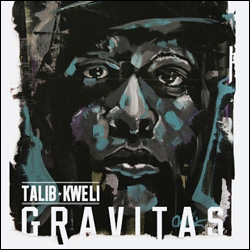
 Elder statesmen status is a difficult achievement in hip-hop. So many artists either burn out or fade away, it’s amazing when one makes it to a third album, let alone out of the decade. A special tip of the cap goes to those who manage to stay active way past the industry’s standard sell date. Brooklyn MC Talib Kweli has earned his status. After debuting on the 1997 album Doom by Cincinnati’s Mood, Kweli has carved out a career that has seen stints in Reflection Eternal (with DJ Hi-Tek), Idle Warship (with Res and Graph Nobel), Black Star (with Mos Def), and of course, as a solo artist. In continuing with his newly prolific profile, Kweli has self-released his sixth solo studio album, Gravitas.
Over the course of his career, Kweli has been dogged by two labels, the first being the champion of the indie underground and the second is that of a “conscious” rapper. While the former is more a byproduct of his time on underground flagship label Rawkus during their heyday, the “conscious” label is a trickier one to unpack. Coming as it does with a specific set of expectations, such typecasting is the kind of thing most artists would runaway from. After all, everyone is a hipster but no one wants to be a hipster. Gravitas is a continuation of that odd tension in Kweli’s career.
There’s been a type of constant pushback against expectations since Kweli’s first solo record, Quality. He is a thoughtful writer with an activist and community improvement bent, but he’s also a person who doesn’t want to be serious all the time. As a result of wanting to show that he’s not always this overly positive person, he slides into trying to be all things to all people, and on Gravitas that means coming off a bit scattershot. The main problem is that while Kweli is undeniably a gifted lyricist, sometimes he tries on outfits that don’t quite fit. For example, on “New Leaders,” he tackles a double-time Southern bounce flow on an equally up-tempo track. While he ably and nimbly attacks the track, it just doesn’t sit right. Throughout the record, there’s a weird ping-pong of styles both vocally and bitwise that instead of showing versatility knocks heads.
Lyrically, Gravitas is as focused as ever. Going from straight knowledge kicking on the Illuminati conspiracy skewering “The Wormhole” to the narrative commentary of “State Of Grace” and the verbal flexing of the Raekwon-assisted “Violations,” Kweli sounds as comfortable as ever. But for whatever reason, something still feels off. Perhaps it’s a sequencing problem; for example, the two unabashed love songs are pushed to the end of the album. There may not be a “right” answer, but maybe some tweaks would make the record hang together better. It would be one thing if the whole album was a swing and a miss, like the waste of Gary Clark Jr. on “Demonology,” but Gravitas is a solid record. It’s just not the record you want it to be.
Your Comments