
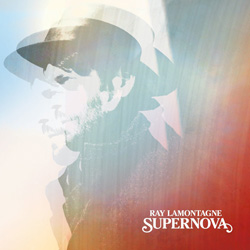
 Even if you think you don’t know Ray LaMontagne, you’ve probably been unwittingly exposed to his music. A favorite of television and movie music supervisors, his songs have been the sensitive, soothing, and engaging voice underscoring a number of critical moments in the pop culture universe. Or maybe you do remember him from his highly acclaimed cover of Gnarls Barkley’s “Crazy.” At a time when there were 50-something versions of the song, his stood out by giving it a stripped down and haunting twist. In many ways, that cover and his seemingly ubiquitous presence as the knowing, warm bath of a voice has seemingly frozen his public perception in amber. He’s the gently bearded folkie who you can trust with your emotions. However, for LaMontagne’s latest and fifth album, Supernova (RCA), he’s pulling a different outfit from the wardrobe.
Joined by the Black Keys’ Dan Auberbach on production, LaMontagne brings some new tricks out of the bag. On Supernova, he and Auberbach jump into the wayback machine and graft some late-60s psych rock and British Invasion paisley style onto LaMontagne’s usual folk excursions. It’s a striking and in your face emersion that’s present from the striking of the first note, while avoiding the usual tropes of nouveau-retro production. Instead of going to the usual benchmarks, it seems like LaMontagne and Auberbach took inspiration from the ’60s B-squad rather than revisiting the well-worn Beatles–Beach Boys axis. There’s a refined and at times almost orchestral vibe to the tracks that on paper seems like it would be the polar opposite of what LaMontagne is about. But LaMontagne launches himself full-bore into the proceedings and sounds completely comfortable throughout the album’s 43 minutes.
Supernova works because while Auberbach does put LaMontagne into a new set of clothes, it’s not a makeover. It’s like a tailored suit with a different cut than he’d usually wear. And on songs like “Julia,” if someone told you it was a lost Strawberry Alarm Clock single, you likely wouldn’t blink an eye. But at its core, it’s still a LaMontange record. Throughout the album his voice remains soulful, if a touch more energized, and he can still write evocative snapshots of relationships. However, in contrast to the style for which he’s most known, here he sounds a bit more playful and vocally elastic. And while it may seem like overkill to keep referring to Auberbach’s roll in the proceedings, a less deft touch could have overwhelmed LaMontagne. Together they’ve struck the right balance of new and old. In a lot of ways, it’s parallel to Danger Mouse’s work on the Black Keys’ Attack & Release. Whether or not it inspires the same type of reappraisal of LaMontagne remains to be seen, but at the very least Supernova shows that the old dog can learn some new tricks.
Your Comments