
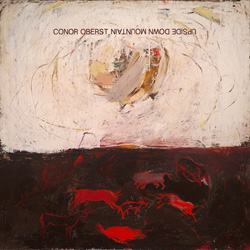
 In nearly every article about Conor Oberst, there’s a reference to his past as a former indie prodigy savant. Clearly this one is no different. However, it increasingly seems like the main topic of discussion should be Oberst’s dauntingly prolific nature. Even taking into account that he started 19 years ago as a 15-year-old, the fact that over the course of his solo career, his time under the Bright Eyes flag, and all of his other side projects and collaborations, it’s astonishing that Oberst has more than 20 full-length records under his belt. Once the EP and singles are figured in, he may be the most prolific songwriter whose name isn’t Robert Pollard. As a result, he’s cultivated a very specific voice. Be it backed by loud rock, electronic underpinnings, or an acoustic guitar, there’s no mistaking Oberst vocally or lyrically. As such, one would think there’s very little new ground to cover, but Oberst has found ways to push and explore new spaces in familiar territory. And such the stage is set for his latest solo album, Upside Down Mountain (Nonesuch).
Another constant, Oberst has been stamped with the tag of “folk musician,” which seems to stem from playing an acoustic guitar on a regular basis. It’s an idea that was gently tweaked with the Monsters of Folk side project, but perhaps “occasional acoustic rocker” is more on the mark. It’s that’s version of Oberst that shows up on Upside Down Mountain, along with the underpinning of some country flavors like pedal steel. Lyrically, the album is very much in the storyteller tradition. Say what you will about him, when he wants to, Oberst can provide a sharply drawn narrative. In the past, he could be a tad obtuse, but here he gets directly to the point, with line after line of carefully constructed turns of phrase designed to elicit specific results.
Musically, Upside Down Mountain very deceptively covers a lot of ground. Outside of the aforementioned country touches, there’s some electronic accents (“Time Forgot”), some rave-up horn-driven moments of mariachi rock (“Hundred Of Ways”), and some straight-ahead rock moments. And yes, there’s even some folk. But what’s notable is that there’s a lot of blurring of the lines that doesn’t feel like blurring. There are no post-anything moments on the album, instead it just sounds like the distillation of a lot of his past work with some new wrinkles thrown in. That could be put down to the fact that this deep into his career Oberst knows who he is musically, and this record reflect that. It may not have the punky flavor of some of his earliest stuff, but you can see that lineage too. At almost an hour, it does feel a bit long, but if the biggest problem is that, like Oberst’s discography as a whole, there’s too much quality, then that’s a nice problem to have.
Your Comments